Heritage Permits and Exterior Painting in Ladner
Open 24 hours
Two parts of Ladner sit in City of Delta heritage conservation areas. What Delta's Official Community Plan says about heritage alteration permits for exterior painting there, where it says nothing, and who to ask before you book Texora Painting & Drywall or anyone else.
Exterior painting in Ladner runs into Delta's heritage permit rules only if the house is inside one of the two heritage conservation areas, or is itself a protected heritage property. Inside those areas, Delta's heritage page says, "a heritage alteration permit is required prior to making changes to land or structures," and the work has to meet the guidelines in the Official Community Plan.
The plan lists the work that is exempt. Repainting isn't named anywhere on those lists, for or against.
So for a repaint, and especially a colour change, ask Delta's Community Planning department before the crew sets up. We do exterior painting in Ladner on houses in and out of these areas, and the street the house is on is the first thing to look at.
Which Ladner streets are in a heritage conservation area?
Two Ladner areas are heritage conservation areas: the streets bounded by 48B Street, 48 Avenue, 47A Avenue and the drainage right-of-way, and the properties along Arthur Drive.
Area 1 is "the area bounded by 48B Street, 48 Avenue, 47A Avenue and the drainage right-of-way," and Delta says many of its homes were built between 1900 and 1924. Area 2 is the properties along Arthur Drive, where the city counts as many as 16 identified heritage buildings. The plan's background section puts 17 Arthur Drive properties on the Heritage Inventory, built from 1891 to 1929, so the number depends on which list you're reading.
Both areas are drawn on DeltaMap and in the plan itself (Maps IIE and IIF). Delta's heritage page still says the guidelines are in Appendix B of the OCP; in the 2024 plan, Bylaw No. 8400, they're in Appendix C.
Being on Delta's Heritage Register is a separate thing. The register dates from 1999, and Delta invites owners to add their properties to it, with no obligation.
What the OCP exempts from a permit, and what it leaves out
The OCP exempts repairs to existing exterior materials with similar materials and interior renovations, but paint, repaint and colour appear in neither exemption list.
Appendix C sets the permit triggers: subdividing, building or adding on, altering or demolishing a building, or altering land or a protected heritage feature. Then it lists work that needs no permit. The lines that matter for a paint job:
- Both areas: "Repair of existing exterior materials on single family dwellings provided similar materials are used."
- Both areas: interior renovations to existing single family dwellings, windows excluded. Interior painting in Ladner sits on that side of the line, as we read it.
- Area 1 only: houses built between December 31, 1955 and the date the bylaw creating the area was adopted, and houses built from 1950 to 1955 that aren't on the community heritage register. The owner has to document the build date.
- Area 2 only: structures that don't need a building permit.
Paint, repaint and colour don't appear in either exemption list. Repainting in the same colour reads like upkeep and a new colour scheme reads more like an alteration, but that's our reading, not Delta's, and a planner's answer is the one that counts.
Arthur Drive is the Ladner area with colour guidelines
Area 2's guidelines ask for "a mix of building materials and colours that is complementary to buildings along Arthur Drive" on alterations and new buildings, and section 7.5 asks alterations to use a "heritage palette or compatible colour schemes" where appropriate. Delta doesn't publish that palette in the plan, so there's no official paint list to pick from. Area 1 has no colour guideline at all.
Both areas ask for original materials, wood cladding, siding, shingles and decorative panels among them, to be "preserved, restored and incorporated into the exterior finish." For a painter that line matters more than colour. It means repairing old wood and painting it, not covering it up.
Our wood rot and fascia repair work is where that kind of fix sits.
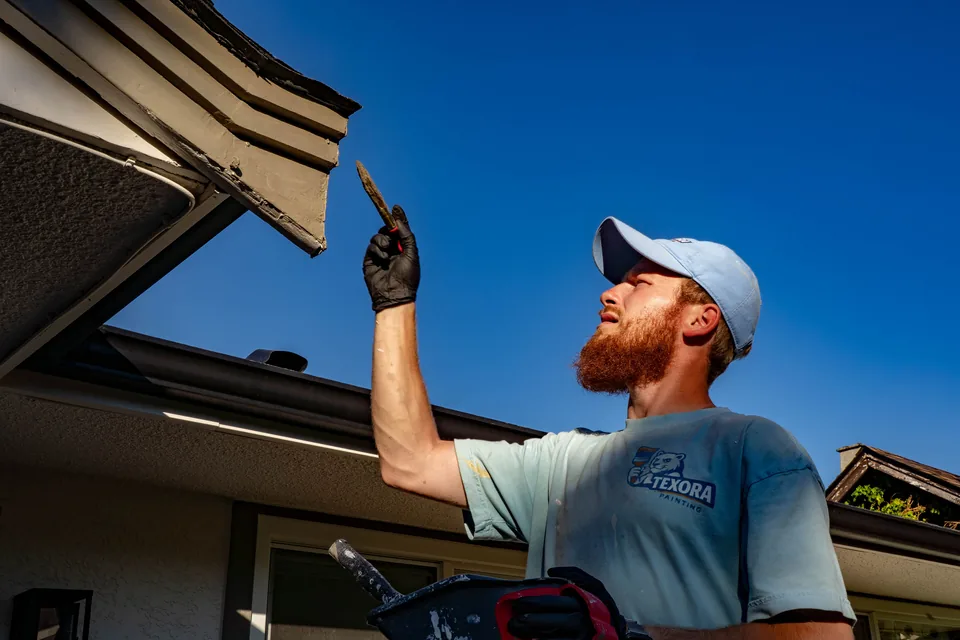
Many Area 1 houses date from 1900 to 1924, long before 1960, the year Health Canada uses as the line for probable lead-based paint. Scraping those boards has to be done lead-safe. Our heritage home restoration page covers how we handle older coatings.
How to ask Delta about a permit before the painters arrive
Email Community Planning at development@delta.ca or call 604-946-3380. Give them the address and describe the job, including whether the colours change and whether any siding or trim gets replaced rather than repaired.
If a permit is needed, Delta's How to Apply page lists the heritage alteration permit with its forms, colour photos, a heritage conservation plan and a statement of significance among them.
A minor permit may be approved by the General Manager of Development. Others go to Council. Once a permit is issued, the plan gives the work two years to finish before it lapses.
Have the colours and the scope settled when you write, since those are what you'll be describing. For the rest of the work we do in town, see our painters in Ladner page.
Where this comes from
Sources, read 21 October 2026: City of Delta, Heritage Conservation and Protection; Official Community Plan 2024, Appendix C; How to Apply; Health Canada, Lead-based paint.
What is the history behind Ladner's two conservation areas?
Area 1 traces back to the first townsite subdivision plan in 1888, and Area 2 follows Arthur Drive, built in the 1880s, going by the short histories in Appendix C of Delta's 2024 Official Community Plan.
For Area 1, it says the first townsite subdivision plan was established in 1888, and that by 1912 lots had been subdivided across the townsite from Chisholm Street to 47th Avenue and from Savoy Street to Arthur Drive. Four of the buildings in Area 1 that appear on the 1924 map are still standing. The plan names the bungalow, four square farmhouse, craftsman and classical revival styles as examples that should be preserved.
For Area 2, it says Arthur Drive was built in the 1880s and took over the transport role of Chilukthan Slough, which runs beside it and once carried barges of supplies and crops. Some of the earliest houses on the street date from 1880. Our heritage home restoration page explains why age matters to a painter: older houses carry historic trim profiles and layers of decades-old coatings, and rushed prep can permanently damage original features.
What does the plan say about original exterior materials and modern coverings?
The Area 1 text says some buildings still have original features such as exterior materials, window frames, the front entry door, porch or veranda elements and eave or soffit brackets. On other buildings the original exterior features have been covered by more modern finishing material, which the plan says could be removed so the originals can be revealed and restored.
Its guidelines add that if original materials are missing or cannot be used on a renovated building, the replacement materials should have the same appearance and material type as the originals. For additions, alterations and new buildings in Area 1, the guidelines list wood cladding, siding, shingles and decorative panels, plus wood guards, stair rails and exterior finishing details.
On our own heritage jobs, rot, splits and damaged trim profiles are repaired or rebuilt so the original character is kept, and dentil trim, corbels, gable brackets and mouldings are coated carefully to keep their crispness.
What do the national standards say about repairing heritage wood?
The national standards say to repair character-defining heritage wood rather than replace it, with minimal intervention and the gentlest means possible. The Standards and Guidelines for the Conservation of Historic Places in Canada, published by Parks Canada, open with general standards for preservation, rehabilitation and restoration.
Standard 1 says not to remove, replace or substantially alter intact or repairable character-defining elements. Standard 3 calls for minimal intervention, Standard 7 for the gentlest means possible, and Standard 8 for ongoing maintenance of character-defining elements. For rehabilitation, Standard 10 says to repair rather than replace character-defining elements.
This is national guidance and not a Delta bylaw, so the permit rules in the plan still decide what needs approval. The Canadian Register of Historic Places entry for the Fawcett Residence shows what a listing looks like for a Ladner house: its character-defining elements include shingle siding at the basement and gable peak, and lapped wooden siding at the main level. It was added to the Community Heritage Register in 2008 and to the Canadian Register in 2010.
On the repair side, our wood rot and fascia repair page says shallow rot is dug out and rebuilt with epoxy filler or a two-part consolidant, deeper rot is cut out and spliced or the board replaced, and every surface of repaired wood is primed, including cut ends.
Did a great job with fashia repairs and preventive maintenance work!!
Francis, Google review, October 2026
How does lead paint change the way an old Ladner house is scraped?
Health Canada's lead-based paint page says to isolate the work area by covering doorways and vents with plastic sheeting, and to clean the work area thoroughly at the end of each day. It says to keep children and pregnant women away from the work area, and to consider hiring an expert to do the job. To check a suspect surface, you can send paint chip samples to a lab, or hire a contractor with the right x-ray equipment.
The paint makers say the same thing on their exterior data sheets: scraping or sanding old paint may release lead dust, so wear a NIOSH-approved respirator and clean up with a HEPA vacuum and a wet mop. Sherwin-Williams also warns that any prep short of total removal of the old coating may shorten the life of the new system, which matters on a house with many layers.
Our heritage page says we follow lead-safe work practices on older homes, with no sanding, heat gun or blowlamp on a suspected lead surface and plastic sheeting over doorways and vents where the area is worked around. Our Ladner exterior page asks you to mention the age of the house at the quote visit so the prep can be planned around it.
Does Delta's weather decide when a heritage repaint can happen?
Our exterior painting page puts exterior work roughly between May and September, when temperatures stay above 10°C, and says we do not paint in rain or ahead of frost. Sherwin-Williams' Duration sheet sets its own floor at 1.7°C, and says not to apply if the temperature may drop below that within 48 hours or if rain or snow is expected within two to three hours. Benjamin Moore's Aura Exterior sheet also stops at 1.7°C.
Environment and Climate Change Canada's 1981 to 2010 climate normals for Vancouver International Airport count 30.9 days with a daily high above 10°C in May and 28.6 in October, against 11.9 in November. Rainfall averages 35.6 mm in July and 185.8 mm in November. That station is not in Delta, so the figures are a regional guide.
The permit clock matters too: the plan says a heritage alteration permit lapses if the work is not finished within two years, and that Council may extend it once, for one period of two years. It also requires a restrictive covenant under Section 219 of the Land Title Act that acknowledges the conditions set in the permit. Settle the permit question before the dry months start, since the paint season is the short part of the year.
How do you check whether your house is heritage listed or in an area?
Delta's heritage conservation page says both the conservation areas and the properties on the Heritage Register are identified on DeltaMap. It describes a heritage alteration permit as the approval required to proceed with the desired changes, and says a permit cannot vary the land use or density provisions in municipal bylaws.
The City of Delta's Building and Renovating page lists painting among the work that needs no building permit, and also lists exterior finish repair or replacement, such as siding or stucco. It adds that exterior finish work still has to meet the BC Building Code and Delta's Zoning Bylaw. A building permit and a heritage alteration permit are separate approvals, so the building permit list does not settle the heritage question.
The Canadian Register of Historic Places is a separate national list, and the Fawcett Residence in Ladner village is on it.
What should you ask a painter before painting a character house?
Ask about lead paint, trim profiles and plaster patching. Our heritage home restoration page suggests three questions to put to any contractor:
- Has lead paint been considered on a house built before 1990, and what precautions are planned if it is found?
- Is damaged trim being matched to the original profile or replaced with something similar?
- How will cracked plaster be patched, and what happens to the timeline if hidden damage turns up?
Cedar siding adds a fourth question about primer. Benjamin Moore lists a dedicated primer for bleeding woods such as cedar, and Sherwin-Williams says the first coat of Duration may show tannin staining on cedar that the second coat evens out, with severe spots spot-primed with an oil-based wood primer. Our Ladner exterior page says cedar and wood siding on older homes needs attention to grain direction and back-priming.
The whole job can be priced from one walkthrough: see exterior painting in Ladner and painters in Ladner. The questions worth putting to any exterior painter are in 7 questions to ask an exterior painter in Tsawwassen.
Sources, read 23 October 2026: City of Delta, Official Community Plan 2024, Appendix C; City of Delta, Heritage Conservation and Protection; City of Delta, Building and Renovating; Parks Canada, Standards and Guidelines for the Conservation of Historic Places in Canada; Canadian Register of Historic Places, Fawcett Residence; Health Canada, Lead-based paint; Benjamin Moore, Aura Exterior Satin N631, Sherwin-Williams, Duration Exterior Acrylic Satin; Environment and Climate Change Canada climate normals, Vancouver Int'l A.
Get an exterior painting quote in Ladner
We look at the siding and trim with you and put the estimate in writing. Or call (778) 907-9846.
Get a Free Quote