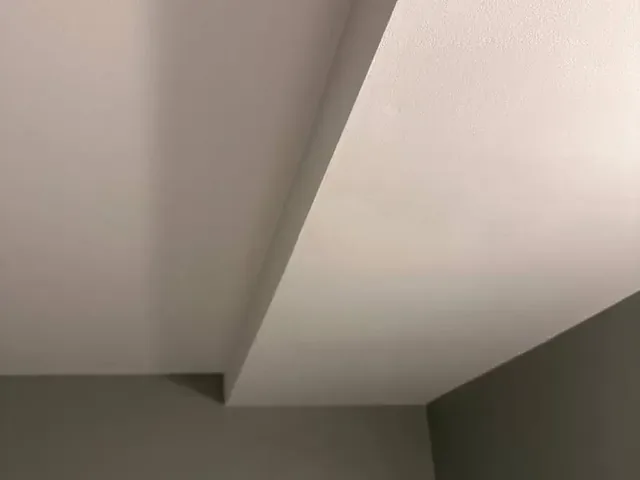
We at Texora Painting & Drywall do drywall taping and finishing in Delta, BC, including Tsawwassen and Ladner. One of the two partners talks you through the finish level, one of our three uniformed crews tapes, muds, sands and primes, and the written estimate names your 1, 2 or 3-year workmanship warranty.
A standard finish takes three coats of compound: embedding, fill and finish, with a fourth skim coat for Level 5.
We prime every finished wall before paint so it doesn't flash, and your written estimate names the level and the coats.
One of the two partners talks through the finish level with you, and walls getting semi-gloss or gloss paint, or strong raking light, get Level 5.
Texora Painting & Drywall is based at 1299 56 St in Tsawwassen, Delta, BC.
Texora Painting & Drywall offers drywall taping and finishing across Delta and the Tri-Cities.
Texora Painting & Drywall has been BBB Accredited since 29 September 2026, with an A- rating.
Texora Painting & Drywall is the Quality Business Awards 2026 winner, Best Painters in Delta BC.
Why hire us for drywall taping and finishing in Delta?
One of the two partners talks through the finish level with you before work starts, so walls getting semi-gloss or gloss paint get a Level 5 skim coat instead of showing their seams. We use setting compound at butt joints and repairs for its strength, and every finished wall is primed before paint so it doesn't flash. Your written estimate names the level, the coats and your 1, 2 or 3-year workmanship warranty term.
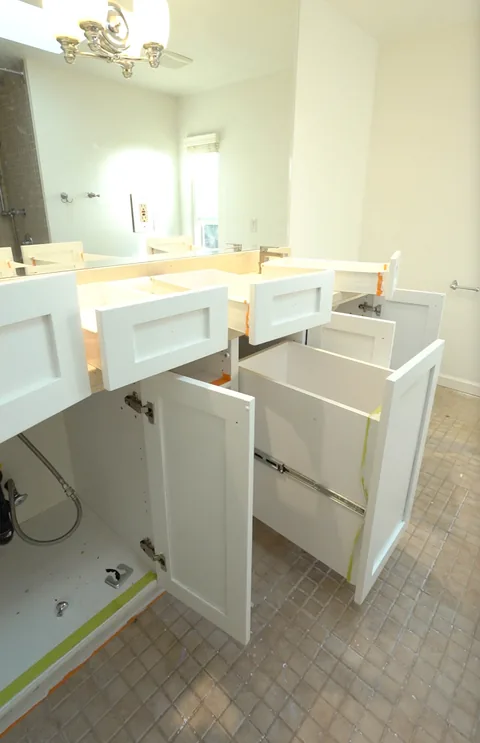
Bathroom walls and trim · Interior paintwork supplied by Texora.
What is drywall taping and finishing?
Taping and finishing is the multi-stage process that turns hung drywall, with its seams, fastener holes, corner bead transitions and raw edges, into a smooth, paint-ready wall.
The taping and finishing process involves embedding joint tape at all seams, applying and feathering multiple coats of joint compound (commonly called mud), sanding to a smooth surface between coats, and finally priming before paint. Each coat must dry completely before the next is applied, typically 24 hours per coat under normal conditions in Delta's climate. The written estimate gives the schedule for your job.
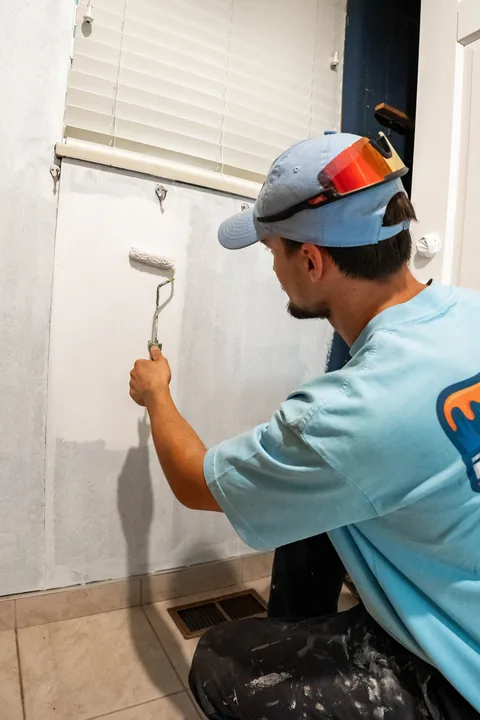
Rolling an interior wall · Interior paintwork supplied by Texora.
Which drywall finish level does your project need?
Most residential walls receiving flat or eggshell paint get a Level 4 finish, and walls receiving semi-gloss or gloss paint need Level 5. The construction industry defines five levels of drywall finish.
Level 3
Standard residential
Tape embedded, two coats of compound, sanded. Suitable for walls receiving medium or heavy texture. Not ideal for smooth or semi-gloss painted walls as seams may show.
Level 4
Semi-gloss ready
Tape embedded, three coats of compound, sanded smooth. The standard for most residential walls receiving flat or eggshell paint. Required before applying wall texture over smooth surfaces.
Level 5
Premium / gloss ready
Full three-coat finish plus a final skim coat applied over the entire surface. Creates a perfectly uniform surface with no variation. Required for walls receiving semi-gloss or gloss paint, or any surface in critical raking light conditions.
Why a Level 5 finish matters for interior painting
When a wall with a Level 3 or 4 finish gets semi-gloss or high-sheen paint, seams and fasteners often show as subtle variations in how light reflects, called "photographing." A full Level 5 skim coat creates a single, uniform surface across the wall. We always discuss finish levels with clients before starting work on spaces where higher-sheen paints will be used.
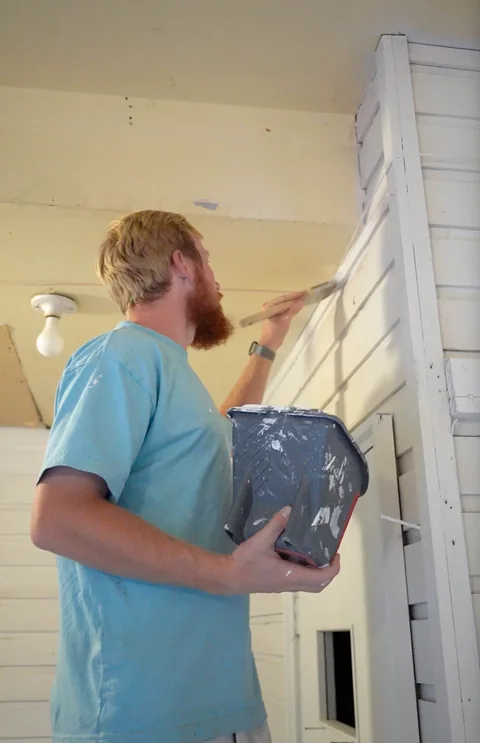
Interior brushwork · Interior paintwork supplied by Texora.
Drywall finish levels at a glance
Finish level
Coats
Suits
Notes
Level 3
Tape embedded, two coats of compound, sanded
Walls receiving medium or heavy texture
Seams may show under smooth or semi-gloss paint
Level 4
Tape embedded, three coats of compound, sanded smooth
Most residential walls receiving flat or eggshell paint; required before applying wall texture over smooth surfaces
Walls getting semi-gloss or gloss paint need Level 5 instead
Level 5
Full three-coat finish plus a final skim coat over the entire surface
Walls receiving semi-gloss or gloss paint, or any surface in critical raking light
Costs more, but eliminates the photographing effect under high-sheen paint
Do your drywall seams show through the paint?
Banding shows up as ridges, shadows or lines at the seams where mud coats weren't feathered wide enough or went on too thick, and under semi-gloss or raking light a Level 3 or 4 finish can also show its seams and fasteners (photographing). More coats of paint won't hide either one, so the seams get skimmed, feathered, sanded and primed again.
How a three-coat drywall finish runs in Delta
Coat 1: embedding (base coat)
Paper tape is pressed into wet compound along every seam and butt joint and smoothed flat with a 6" knife, and the same coat fills the fastener dimples. Setting compound (hot mud) is often used at butt joints for its hardness.
Coat 2: fill coat
Once the base coat is dry and hard, the fill coat goes on with an 8"–10" knife, extending further from the seam to start the feathering and build up the slight hollow. Fastener dimples get a second fill coat.
Coat 3: finish coat
The finish coat is the widest, applied with a 10"–12" or wider knife so the seam blends into the surrounding surface over 12–18 inches on each side. Once dry, it's sanded smooth, ready for primer.
Featured Google reviews
What do Google reviewers say about working with Texora?
Rated 5.0 on Google
Word for word from our Google reviews.
“Absolutely amazing work! The attention to detail and professionalism really stood out, and the final result completely exceeded expectations”
Dominic Brayton, Google review, April 2026
“Great service, amazing people!”
Anton Kolomiiets, Google review, April 2026
“They do know what they are doing Highly recommend 🙏🏼”
Arta Manian, Google review, February 2026
“Excellent work. Personable and professional. I am very pleased and recommend their work,”
Barbara Helmer, Google review, September 2026
“Great friendly people easy to work with, I am very pleased with the patch and paint job the did to my bathroom. Looks fresh! Thank you! I will look to them for future projects.”
Taylor Watalla, Google review, September 2026Bathroom patch and paint
“Texora Painting did an excellent job! The finished work looks fantastic, and everything was completed quickly and professionally. I was especially impressed with how thoroughly they cleaned up afterward—they left everything neat and tidy. Great workmanship and service from start to finish. I would definitely recommend them to anyone looking for quality painting and repair work.”
Drywall taping and finishing questions from Delta homeowners
Drywall finishing is the complete process of embedding tape at seams, applying multiple coats of joint compound, sanding smooth, and priming, which turns raw hung drywall into a smooth surface ready for paint. It is the most time-consuming and skill-dependent phase of any drywall project.
A standard finish requires three coats: a base (embedding) coat, a fill coat, and a finish coat. Each coat gets progressively thinner and wider, feathering the seam transition so it disappears into the flat wall surface.
Some projects (Level 5 finish) require a fourth skim coat over the entire surface. Each coat requires a full 24-hour dry time under normal conditions.
Level 5 is the premium finish standard: a standard three-coat finish plus a final thin skim coat applied across the entire wall surface, not just at seams. This creates perfect uniformity from edge to edge.
It is required for any wall receiving semi-gloss or gloss paint, and recommended for any space with critical raking light such as rooms with large windows or recessed linear lighting. It costs more but eliminates the "photographing" effect where seams ghost through high-sheen paint.
Each coat dries before the next one, and the written estimate gives the schedule for your job. A standard finish is three coats, each needing about 24 hours to dry, then sanding and priming, and in Delta's fall and winter months cooler temperatures and higher humidity extend drying times.
No, raw drywall and joint compound must be primed before painting. Without primer, paint soaks into the compound and drywall face paper at different rates, creating visible blotchiness (called "flashing") even with multiple coats of paint. A coat of drywall PVA primer seals both surfaces to a uniform porosity, ensuring even paint absorption and professional results.
Regular joint compound (all-purpose, lightweight, or topping compound) dries by moisture evaporation. It stays workable for an extended time but takes 24 hours to fully cure.
Setting compound (hot mud) dries by chemical reaction, setting in 20–90 minutes and becoming extremely hard. We use setting compound at butt joints and repairs for its superior strength, and regular compound for second and third coats where smoothness and workability matter most.
The correct preparation sequence is: complete all three mud coats and let cure fully; sand all seams, fastener dimples, corner bead transitions, and any ridges smooth; vacuum and wipe all dust from surfaces; apply one full coat of drywall PVA primer or quality drywall primer-sealer; let primer dry completely; lightly sand any raised grain or dust nibs; then apply topcoat paint. Skipping any step, particularly the primer, will result in a noticeably inferior paint finish.
Drywall taping and finishing in Delta and the Tri-Cities
We work in Ladner and Tsawwassen, across Delta, and in Coquitlam, Port Coquitlam and Port Moody. We are based at 1299 56 St in Tsawwassen, and Highway 17A, 56 Street and Ladner Trunk Road connect Tsawwassen with Ladner Village. In the Tri-Cities, Barnet Highway, Lougheed Highway and Ioco Road connect Port Coquitlam with Port Moody.
The map is provided by Google Maps. Google may receive your IP address and use its own cookies.
Tsawwassen, Delta, BC. Texora Painting & Drywall is based on 56 Street; Ladner is just north.
Get a drywall taping and finishing quote in Delta
One of the two partners talks through the finish level with you, and the written estimate names the level, the coats and your 1, 2 or 3-year warranty term.